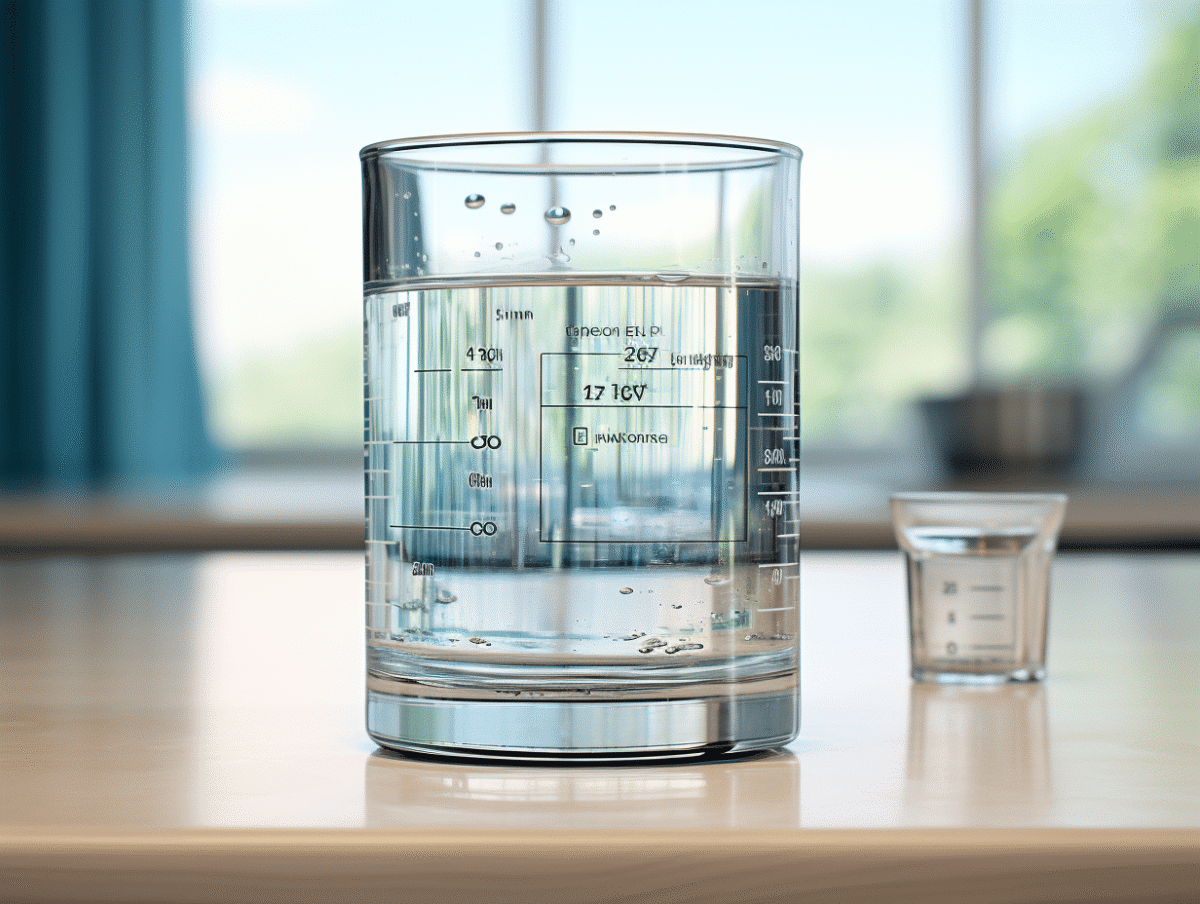
In the world of cooking, chemistry, or simply for calculating dosages in everyday life, knowing how to convert units of volume is essential. Liters and milliliters are two commonly used measures for quantifying liquids. One liter corresponds to a volume of one thousand milliliters. The conversion is relatively simple: you just need to multiply or divide by one thousand. This skill proves useful when adapting recipes, measuring medications, or even when filling the tank of a machine that requires a precise amount of liquid.
Understanding the relationship between liters and milliliters
The conversion between liters and milliliters is based on a fundamental rule: 1 liter equals 1000 milliliters. This linear relationship ensures that the transition from one unit of measurement to another is straightforward, through a simple mathematical operation. The liter, a unit of volume measurement in the international system, finds its sub-multiple, the milliliter, for smaller quantities requiring greater precision.
In practice, to convert a volume in liters to its equivalent in milliliters, multiply the number of liters by one thousand. Conversely, divide the number of milliliters by one thousand to obtain liters. To convert 1/4 of a liter to ml, multiply 0.25 (which represents 1/4) by 1000, resulting in 250 milliliters.
A conversion table can be useful for visualizing these correspondences and facilitating repetitive or complex conversions. This table indicates the multiples and sub-multiples of the liter, allowing you to see at a glance how many zeros to add or subtract when converting units.
It is also relevant to note the equivalence between the volume and weight of water: 1 liter of water is equivalent to a weight of 1 kilogram. This unique property of water often simplifies calculations requiring a conversion between volume and mass, particularly in cooking or chemistry. However, this equivalence does not apply to all substances, as density plays a significant role in the relationship between mass and volume.

Step-by-step guide to converting liters to milliliters
To successfully convert liters to milliliters, follow these precise and systematic instructions. Take the initial data, the volume in liters, and prepare to perform a simple multiplication operation. The goal: to transpose a volume measurement into another unit, more suitable according to the precision requirements.
First, identify the volume in liters to convert. Whether this number is whole, decimal, or a fraction, the approach remains the same. Grab a pen and paper or a calculator to get started. Multiply the number of liters by 1000. This is the only mathematical step needed, as 1 liter equals 1000 milliliters by definition.
The conversion table can be a particularly useful tool in this process. It facilitates the visualization of the multiples and sub-multiples of the liter, thus allowing for instant understanding of the equivalences. To use it, simply locate the column for liters and follow the corresponding row to the column for milliliters.
For those who prefer interactive educational materials, exercise sheets are available for download. These resources provide practical cases and concrete examples, thus promoting understanding and application of the conversion rules. Use the provided links to access these documents and enhance your proficiency in handling volume measurements.