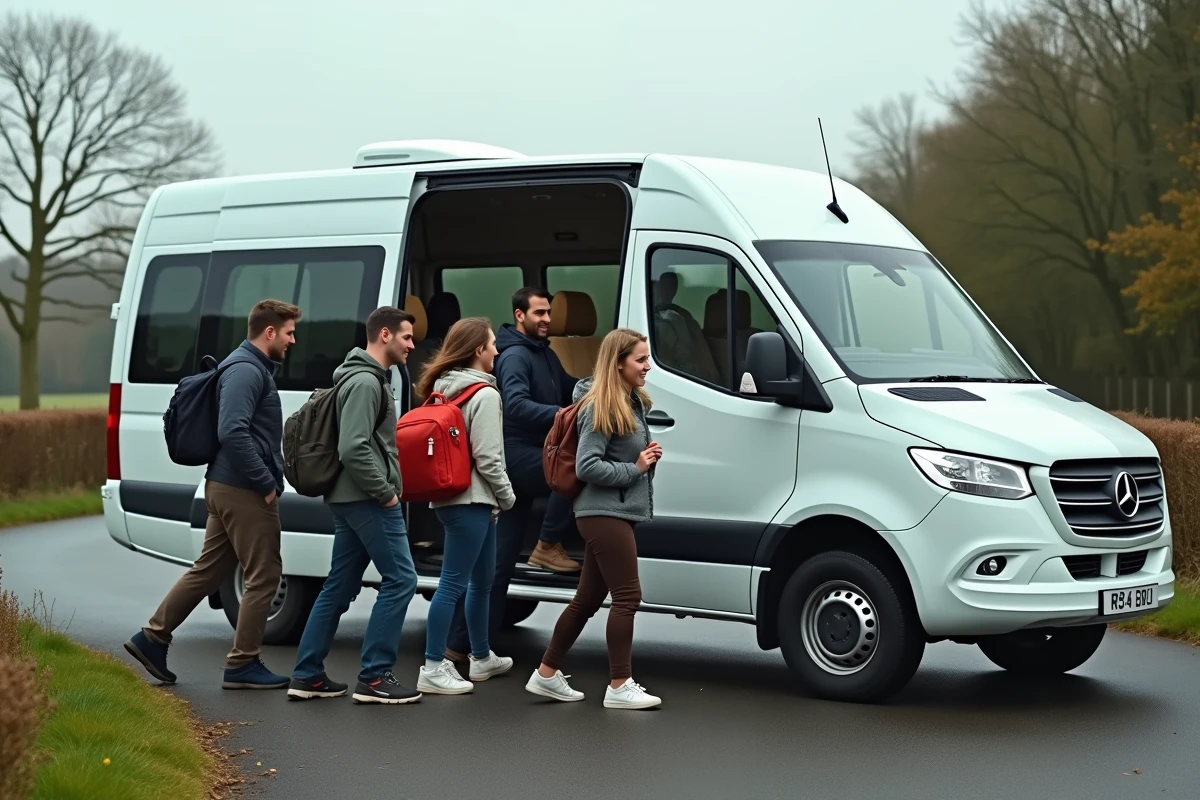
The intermediate transport vehicle segment holds a special place in the landscape of collective mobility. Between the van limited to eight passengers and the oversized coach for a small group, the 15-seat minibus meets a specific need, but its use raises questions that commercial brochures often overlook: required driving licenses, access to restricted urban areas, and actual management of driving times.
Licenses and GVW: the regulatory criterion that comparisons overlook
Most online content summarizes the 15-seat minibus as a matter of comfort and price. However, the first filter is regulatory. In France, the required license depends on the total weight of the vehicle, not just the number of seats. A 15-seat minibus with a GVW below the regulatory threshold can be driven with a category B license, while a heavier model, even with the same number of seats, falls into a higher category.
This distinction radically changes the scope of use. For a trip organized among friends or family, the possibility of driving oneself reduces the budget. For a professional or associative trip with a driver, the question of the license shifts to the provider, but it conditions the type of vehicle offered and, by extension, the price.
Before comparing quotes, checking the license category associated with the proposed model helps avoid unpleasant surprises on the day of departure. When considering the choice of a 15-seat minibus for a given trip, this verification should precede any consideration of comfort or equipment.

Low emission zones and minibuses: urban access under conditions
Low emission zones (LEZ) are multiplying in major French urban areas. Their impact on group transport remains underestimated. Depending on the engine type and the vehicle’s Crit’Air sticker, the same trip may be allowed or prohibited based on the city crossed and the date of enforcement of local restrictions.
An old diesel minibus, perfectly functional on the highway, may be denied access to the center of Lyon, Paris, or Strasbourg on certain days. Conversely, a recent model that meets the strictest standards can circulate without constraint. This parameter weighs as heavily as the number of seats in the choice of vehicle.
15-seat minibus and Crit’Air sticker: points to check
- The Crit’Air classification of the vehicle offered by the rental company, which depends on the year of registration and the type of engine (diesel, petrol, hybrid)
- The restrictions in effect in each destination or transit city, as implementation schedules vary from one urban area to another
- The possibility of requesting a temporary exemption for certain collective transport vehicles, according to municipal regulations
For a group trip passing through several city centers, the itinerary itself becomes a selection criterion for the vehicle. A recent minibus offers a freedom of movement that older individual cars may not necessarily have.
Driving times and break management on long trips
Classic comparisons pit the minibus against the “multiple cars” solution in terms of cost and comfort. A rarely addressed angle concerns driver management. A single vehicle with a single driver simplifies coordination, but also imposes the need to respect break times, especially on long journeys.
When a group rents a minibus with a professional driver, the rules regarding driving and rest times apply to the provider. The trip is planned in advance, stops are anticipated, and the responsibility lies with the transport company. This framework reassures passengers and eliminates the mental load associated with navigation and fatigue.
Without a driver, the situation differs. The designated driver within the group assumes the road alone. On a trip lasting several hours, fatigue accumulates faster than behind the wheel of a sedan, as the size of the vehicle requires sustained attention. Alternating drivers assumes that several group members have the appropriate license for the rented model.

The real economic calculation of a 15-seat minibus for a group
Narrowing the comparison to “a minibus versus two cars” skews the analysis. The real comparison pits a minibus against several segmented solutions: individual rentals, multiple insurances, accumulated tolls, separate parking, fuel for each vehicle.
Cost items often underestimated with multiple vehicles
- Toll fees multiplied by the number of cars, while a single passage suffices for a minibus
- Parking in the city center, where finding a spot for a minibus is simpler than parking three or four cars close to each other
- Supplementary insurances charged on each individual rental contract, which add up quickly
On the other hand, the 15-seat minibus has its own additional costs. The fuel consumption of a vehicle of this size exceeds that of a standard car, even if it remains lower than the total combined of several vehicles. Cleaning, the deposit, and any return fees also weigh in the balance.
The real financial gain appears especially from around ten passengers. Below that, a large MPV or two family cars can compete in total cost. Beyond that, the minibus gains the advantage in almost all categories.
Comfort and friendliness: what passengers remember from the trip
Group transport is not just a logistical issue. Traveling together in the same vehicle transforms the journey into a shared moment. Passengers in a 15-seat minibus generally have more space per seat than in a compact car, with more direct access to luggage than in a coach’s hold.
Field feedback varies on comfort depending on the models. Some minibuses offer reclining seats, individual air conditioning, and USB ports. Others, older or entry-level models, provide minimal equipment. Comfort varies as much from one model to another as from one vehicle category to another.
The choice of a 15-seat minibus for group trips hinges on a balance between regulatory framework, urban constraints, and overall budget. The answer is not universal: it depends on the actual number of passengers, the planned itinerary, and the expected level of service. Asking these questions before requesting a quote helps avoid a vehicle that is too large, too expensive, or unsuitable for the cities traversed.