
Your car accelerates, but you feel that it is holding something back. It’s not just an impression: manufacturers intentionally restrict engines via the electronic control unit. Stage 1 engine tuning involves modifying this software mapping to unleash the potential already present under the hood, without touching the mechanical parts.
What the ECU restricts and how stage 1 corrects it
The engine control unit (ECU) constantly manages fuel injection, turbo pressure, and ignition timing. Manufacturers calibrate these parameters with wide safety margins, designed to cover all possible usage conditions, all markets, and all fuel qualities.
Stage 1 only intervenes on this software layer. A tuner reads the original mapping stored in the ECU, then adjusts the injection curves, boost pressure, and ignition timing. No mechanical parts are replaced or added.
A dip in acceleration uphill or a vague response time during overtaking often comes from the manufacturer’s conservative margins.
The mapping work aims precisely to correct these flaws while respecting the mechanical tolerances of the engine.
Before considering stage 1 engine tuning, it is important to understand that the gain directly depends on the type of engine. Turbo engines (gasoline or diesel) respond much better than naturally aspirated engines, as boost pressure offers a significant optimization margin.
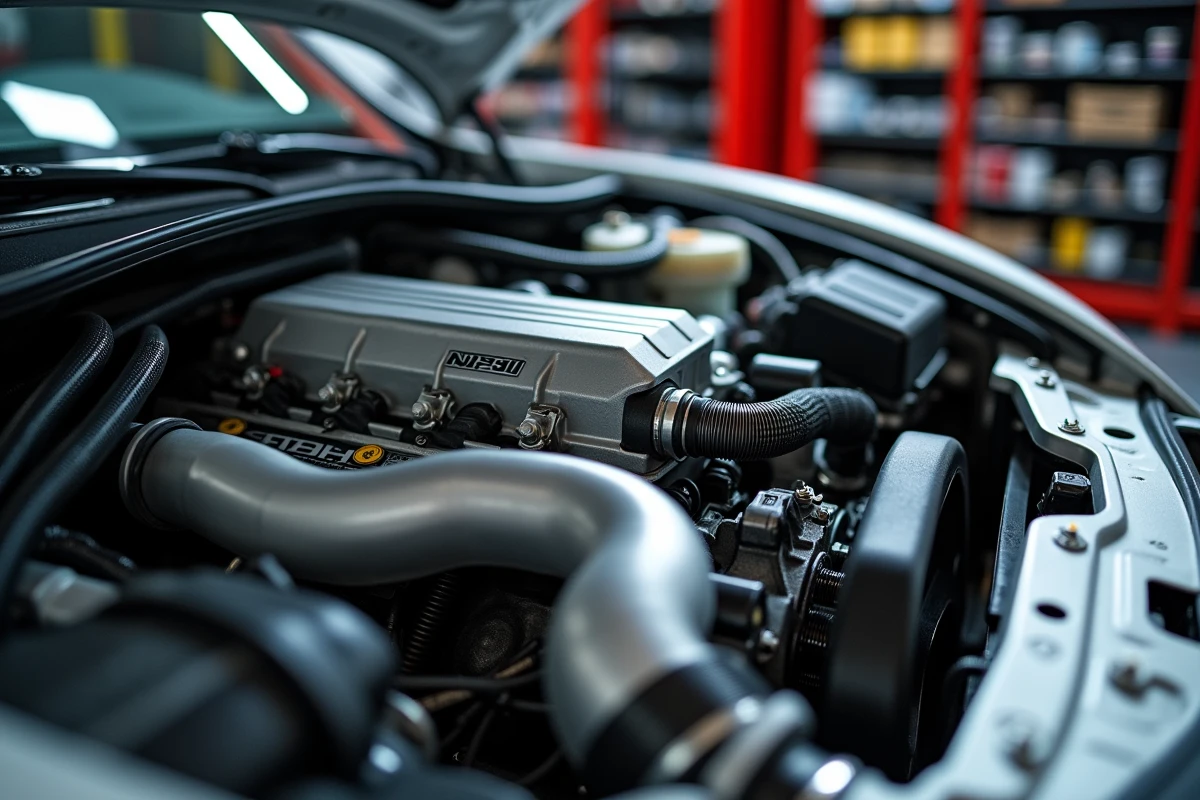
Stage 1 and E85 conversion: the combo that has become standard for turbo gasoline engines
In recent years, a trend has emerged among tuners: combining stage 1 with an E85 superethanol conversion on turbo gasoline engines. This is no coincidence.
Ethyl alcohol has a physical property that directly interests engine mapping: its internal cooling power is greater than that of regular gasoline. When the fuel vaporizes in the combustion chamber, ethanol absorbs more heat. The temperature in the cylinder decreases, which reduces the risk of knocking (uncontrolled detonation).
In practice, this thermal margin allows the tuner to program more advanced ignition timings while remaining within acceptable knocking zones. The engine then produces more power and torque at the same RPM, with the added bonus of a significantly lower cost per liter compared to SP95 or SP98.
Why this combo works better than a simple ethanol conversion
An E85 conversion alone adjusts the mapping so that the engine can accept ethanol without breaking. The mixture runs richer, volumetric consumption increases, but power remains close to stock.
The FlexFuel stage 1 goes further: it actively exploits the cooling properties of ethanol to push the limits of the mapping. The gain in power and torque exceeds that of a standard gasoline stage 1, because the thermal margin is wider. This is why this package has become the most common request among tuners specializing in recent turbo gasoline engines.
Technical inspection and insurance: the constraints to anticipate
Modifying an engine’s mapping has consequences beyond driving pleasure. Two points deserve serious attention before going on the dyno.
Technical inspection and OBD detection
Technical inspection centers have equipped themselves in recent years with tools capable of reading data from the OBD (on-board diagnostics) system. A poorly calibrated stage 1 can cause:
- Inconsistent torque values with the manufacturer’s specifications, triggering a report during the inspection
- Smoke or emission levels that exceed standards, even without the removal of the particulate filter or EGR valve
- A re-inspection for OBD or pollution faults, if the sensors report aberrant data to the inspector
A competent tuner calibrates the mapping so that OBD values remain consistent. This is a crucial selection criterion.
Insurance and modification declaration
An engine reprogramming modifies the technical characteristics of the vehicle. Auto insurance contracts cover a vehicle that complies with its registration document. In the event of a claim, if the expert finds an undeclared modification, the insurer may reduce or deny compensation.
Any reprogramming should be declared to the insurer, even if it does not change the registration document. Several brokers and consumer associations have raised awareness about this risk in recent years, particularly for young drivers and recent vehicles that already face high surcharges.

Choosing a stage 1 engine tuner: the technical criteria that matter
The reprogramming market attracts very diverse profiles, from mechanics trained in mapping to resellers of generic files downloaded online. The difference in results is considerable.
- The tuner must perform a complete diagnostic before any intervention: reading faults, checking mechanical condition (turbo, injectors, spark plugs, cooling circuit). An engine in poor condition cannot support a more demanding mapping
- The mapping must be written or adapted for your specific engine, not a generic file applied to all vehicles of the same brand
- A run on the dynamometer before and after reprogramming allows for checking real gains and detecting any anomalies (irregular power curve, knocking, excessive temperature)
- Reversibility must be guaranteed: the tuner keeps the original mapping and can rewrite it in the ECU if necessary
Ask if the file is personalized after real-time logs or simply flashed in a few minutes. The duration of the intervention is not a guarantee of quality, but a serious reprogramming requires at least an engine data logging to refine the settings.
Stage 1 remains the most accessible modification to enhance the performance of a turbo vehicle, provided that the subject is treated with the same rigor as a mechanical intervention. The engine control unit tolerates a lot, but not approximation.